
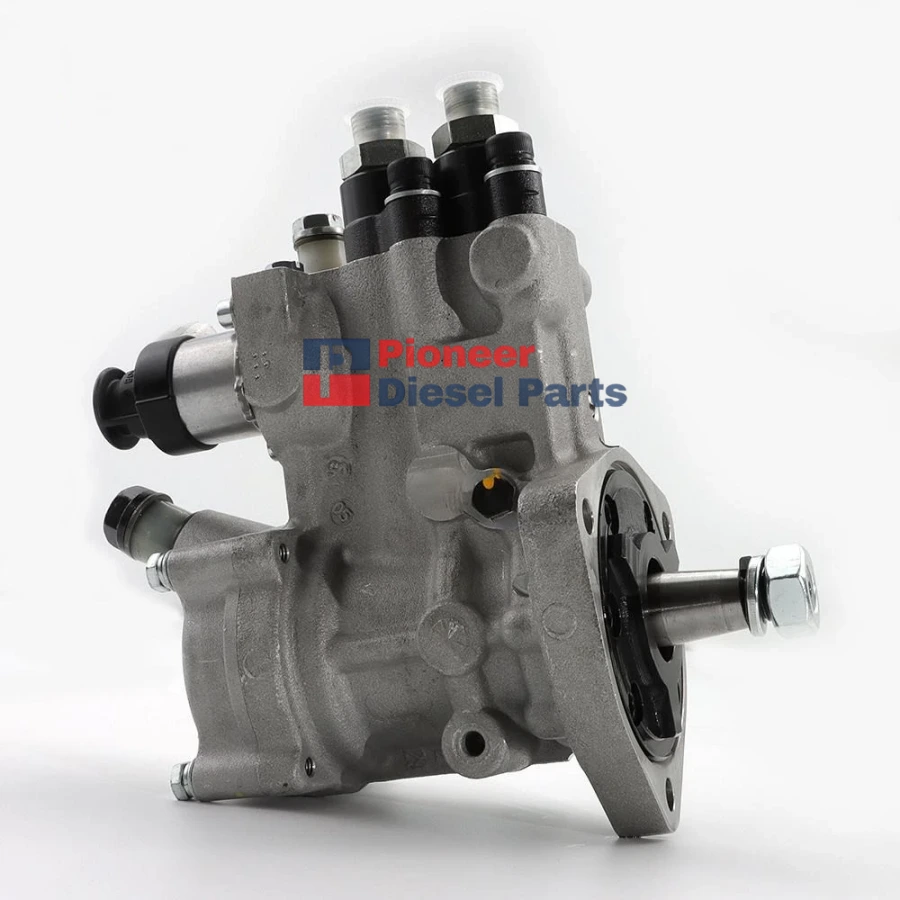
The Bosch CB18 high-pressure pump 0445025084 is a second-generation common rail diesel fuel injection pump designed for light commercial vehicles and off-highway applications in emerging markets. It features an in-line twin-plunger design and operates at system pressures of 1,400–1,600 bar (140–160 MPa).
Unlike fuel-lubricated CP3 pumps, the CB18 uses an engine oil lubrication system, which improves tolerance to fuel quality variations and reduces sensitivity to low-lubricity diesel.
The 0445025084 variant is commonly applied in engines from JMC, Yuchai, Great Wall, Yunnei, and Foton platforms, and is typically used in China III/IV and Euro III emission-level diesel systems.
1. Overview
The Bosch CB18 belongs to the CB series common rail pump family (CB08 / CB18 / CB28) developed for cost-sensitive and emerging diesel markets.
It is designed for:
- Stable rail pressure generation under variable fuel conditions
- Light-duty and medium-duty diesel systems
- On-road and off-highway applications
The CB18 (0445025084) is a production variant widely used in Chinese OEM diesel platforms, including commercial vehicles and agricultural machinery.
📌 Technical positioning: CB18 is classified as a value-line second-generation Bosch common rail pump system optimized for durability and fuel flexibility rather than maximum pressure output.
2. Technical Specifications
| Specification | Value |
|---|---|
| Model | Bosch CB18 |
| Part Number | 0445025084 |
| Pump Type | In-line twin-plunger (2-cylinder pumping element) |
| System Pressure Range | 1,400 – 1,600 bar |
| Transmission Ratio | 1:2 (camshaft to engine speed) |
| Lubrication System | Engine oil-lubricated |
| Fuel Supply System | Integrated internal vane feed pump |
| Fuel Inlet Pressure | 0.35 – 1.0 bar |
| Overflow Valve Setting | 4.0 bar |
| Operating Temperature | −40°C to 80°C |
| Estimated Weight | ~5.0 kg |
| Emission Compliance | China III / China IV / Euro III |
Key Engineering Characteristics
- Twin-plunger inline design
- Two reciprocating plungers driven by camshaft
- Each plunger operates in alternating compression cycles
- Oil lubrication architecture
- Lubrication is independent from diesel fuel
- Reduces wear risk in low-sulfur or low-lubricity fuel environments
- Integrated vane supply pump
- Provides low-pressure fuel delivery internally
- Eliminates need for external lift pump in many configurations
- Electronic fuel metering unit (MPROP)
- ECU-controlled solenoid valve
- Regulates fuel quantity entering high-pressure chambers
- Overflow protection valve
- Opens at approx. 4 bar inlet overpressure
- Prevents hydraulic system damage and cavitation effects
3. Application – Engines and Vehicle Platforms
Primary OEM Applications
| OEM | Application Scope |
|---|---|
| JMC (Jiangling Motors) | Isuzu-based 4JB1 diesel platforms |
| Yuchai | Light and medium diesel engines |
| Great Wall | Pickup and SUV diesel variants |
| Yunnei | Industrial diesel engines |
| Foton | Commercial trucks and vans |
| Quanchai | Agricultural and utility engines |
Application Segments
- Light commercial vehicles (LCV)
- Diesel pickup trucks
- Agricultural machinery
- Construction equipment (light–medium duty)
- Industrial generator systems
Cross Reference Numbers
| Type | Number |
|---|---|
| Bosch | 0445025084 |
| OEM Reference | 820B336106 |
| OEM Reference | J8M00-1111100SF1-A38 |
4. Working Principle (System Operation)
1. Fuel Supply Stage
Fuel is drawn through an integrated vane pump inside the CB18 housing.
Required inlet pressure: 0.35–1.0 bar.
2. Fuel Metering Control
The MPROP (Metering Proportional Valve) is ECU-controlled:
- Controls fuel entry into pumping chambers
- Enables zero, partial, or full delivery modes
- Directly affects rail pressure stability
3. Mechanical Drive System
The camshaft system performs three functions:
- Drives twin plungers
- Drives internal vane pump
- Synchronizes pump timing with engine rotation
Transmission ratio: 1:2 (pump runs at half engine speed)
4. High-Pressure Generation Cycle
Intake Stroke
- Plunger moves downward
- Intake valve opens due to pressure differential
- Fuel enters chamber
Compression Stroke
- Plunger moves upward
- Intake valve closes
- Pressure rises above rail pressure
- Delivery valve opens → fuel enters common rail
5. System Protection Logic
Overflow valve activates when inlet pressure exceeds 4 bar, returning excess fuel to the return line to prevent hydraulic overload.
6. Closed-loop ECU Control
The ECU continuously monitors:
- Rail pressure sensor
- Engine load demand
- Injection timing map
It adjusts MPROP duty cycle to maintain target rail pressure stability.
5. Failure Modes and Diagnostic Analysis
Common Failure Modes (Field Data-Based)
| Failure Mode | Technical Cause |
|---|---|
| Plunger O-ring wear | Seal fatigue / pressure cycling |
| MPROP valve sticking | Particulate contamination |
| Vane pump wear/jam | Fuel contamination or debris |
| Internal rust formation | Water ingress in fuel system |
| Oil contamination | External lubrication circuit failure |
| Intake valve leakage | Seat wear or debris impact |
Failure Symptoms
- Extended cranking / no-start condition
- Reduced rail pressure under load
- Engine hesitation or power loss
- Diagnostic fault codes (rail pressure deviation)
- Fuel leakage around pump housing
- Unstable idle speed
Diagnostic Guidelines
- Verify inlet fuel pressure: 0.35–1.0 bar
- Inspect fuel filter for particulate contamination
- Check MPROP electrical resistance and response curve
- Analyze fuel for water content
- Inspect return line for abnormal flow rate
6. Repair and Service Strategy
Service Design Features
- Isolated lubrication system reduces contamination risk and improves reliability.
- Modular internal components enable partial repair
- Compatible with standard Bosch service procedures (CB platform)
Common Service Operations
| Repair Item | Description |
|---|---|
| MPROP replacement | Electrical metering correction |
| Overflow valve cleaning | Removes particle blockage |
| Seal replacement | Restores pressure integrity |
| Vane pump cleaning | Restores fuel supply stability |
| Full pump replacement | Severe wear or catastrophic failure |
Preventive Maintenance
- Replace fuel filters regularly
- Maintain clean diesel fuel supply
- Drain water separator system
- Ensure clean engine oil quality
- Avoid air ingress after maintenance
- Monitor early rail pressure deviations
7. CB18 vs CB Series Overview
| Feature | CB08 | CB18 | CB28 |
|---|---|---|---|
| Target Application | Micro diesel engines | LCV / off-highway | Medium-duty CV |
| Max Pressure | ~1600 bar | 1400–1600 bar | ~1800 bar |
| Lubrication | Oil | Oil | Oil |
| Market Position | Entry-level | Value-line mainstream | Higher output segment |
8. CB18 vs CP3 Technical Comparison (Data-Driven)
| Feature | CB18 | CP3 |
|---|---|---|
| Pump Type | Inline twin-plunger | Radial 3-plunger |
| Max Pressure | 1400–1600 bar | Up to 1800 bar |
| Lubrication | Engine oil | Diesel fuel |
| Design Focus | Fuel tolerance + cost efficiency | High durability + global heavy-duty use |
| Power Range | Up to ~110–200 kW (platform dependent) | Heavy-duty truck engines (200+ kW) |
| Fuel Sensitivity | Low sensitivity | Medium sensitivity |
| Market Segment | Emerging markets | Global heavy-duty OEMs |
Engineering Interpretation
- CB18 is optimized for fuel variability tolerance
- CP3 is optimized for maximum performance and heavy-duty durability
- CP3 provides higher pressure ceiling (+~200 bar advantage)
- CB18 provides better resistance to low-lubricity fuel conditions
9. Other models in the same series and related reading
The CB18 is part of the Bosch CB series (CB08, CB18, CB28), designed for light commercial and off-highway diesel systems. It focuses on stable rail pressure, durability, and better fuel quality tolerance in 1,400–1,600 bar applications.
- 0445025039
- 0445025050
- 0445025072
- 0445025091
Read about other related models:
- Bosch CP4 High-Pressure Pump 0445010622 – Specifications, Applications, and Failure Analysis
- Bosch CP3 0445020300 High Pressure Fuel Pump – Specs, Applications & Failure Guide
- 0445020122
- 0445020017
10. Frequently Asked Questions
1. What vehicles use Bosch CB18 0445025084?
It is used in diesel engines from JMC, Yuchai, Great Wall, Yunnei, and Foton, mainly in light commercial and industrial applications.
2. What is the maximum pressure of CB18 pump?
The CB18 operates between 1,400 and 1,600 bar, depending on ECU calibration and system configuration.
3. How is CB18 different from CP3?
CB18 uses engine oil lubrication and inline twin-plunger design, while CP3 uses fuel-lubricated radial piston technology with higher pressure capability up to 1,800 bar.
4. What are common CB18 failures?
Typical issues include MPROP sticking, vane pump contamination, seal wear, and internal rust due to water in fuel.
5. Is CB18 suitable for poor fuel quality regions?
Yes. Its oil-lubricated design provides higher tolerance to fuel quality variation compared to fuel-lubricated pump systems.
6. Can CB18 replace CP3 pump?
No. CB18 and CP3 are designed for different fuel systems and cannot be directly swapped.
CB18 works in lower-pressure light-duty systems, while CP3 is used in heavy-duty high-pressure applications.
7. What are early symptoms of CB18 pump failure?
Common early signs include:
- Difficult starting
- Weak acceleration
- Unstable rail pressure
- Increased return fuel
- Limp mode activation
Conclusion
The Bosch CB18 (0445025084) is a value-line common rail high-pressure pump designed for light commercial and off-highway diesel applications in emerging markets. With its in-line twin-plunger structure, oil-lubricated design, and 1,400–1,600 bar operating range, it offers stable performance under variable fuel conditions. Compared with higher-end systems like CP3, the CB18 prioritizes cost efficiency and fuel tolerance while maintaining reliable rail pressure control for modern diesel engine requirements.
Disclaimer
Bosch and Cummins part numbers are used for compatibility and identification purposes only. All products described in this article are aftermarket replacement parts and are not claimed to be original Bosch or Cummins products unless explicitly stated.