
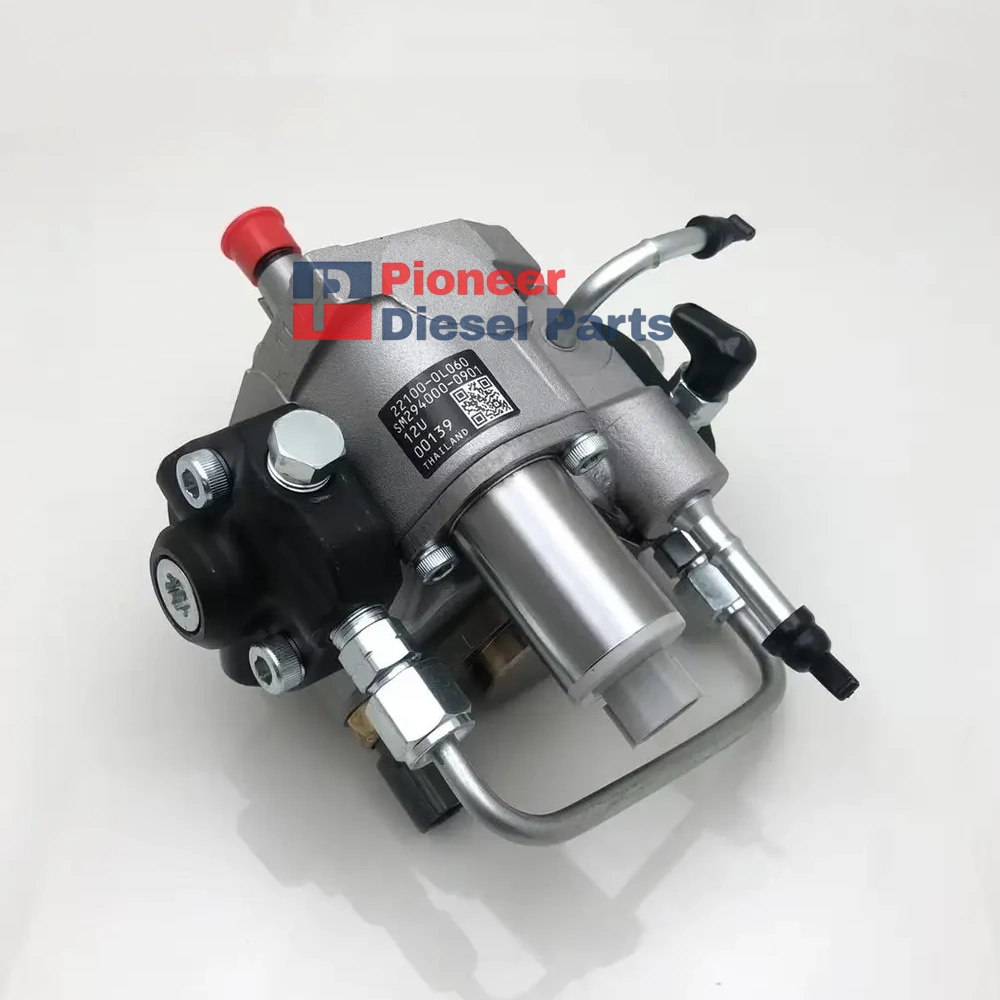
The Denso HP3 294000-0901 is a second-generation common rail high-pressure fuel pump used in Toyota 1KD-FTV and 2KD-FTV diesel engines (Hilux, Hiace, Dyna).
It can generate up to 1,800 bar fuel pressure using a two-cylinder radial piston design with an integrated SCV (Suction Control Valve).
The most common failure causes include:
- SCV valve malfunction (most frequent)
- Fuel contamination
- Internal plunger and barrel wear
Typical symptoms include:
- Hard starting or long cranking
- Power loss under load
- DTC codes P0087 / P0088
- Low rail pressure instability
With proper maintenance, lifespan can reach 200,000–250,000 miles.
1. What Is the Denso HP3 294000-0901 Pump?
The Denso HP3 series is a lightweight, electronically controlled, two-cylinder radial piston common rail pump designed for passenger cars and light-duty vehicles. The Denso HP3 is classified as Denso’s second-generation common rail pump.
The 294000-0901 variant is specifically matched to Toyota 1KD-FTV (3.0L) and 2KD-FTV (2.5L) D-4D platforms.
Key Engineering Features
Engineering Highlights
- Two plungers are positioned symmetrically above and below on the outside of the ring cam.
- Each plunger pumps fuel in a reciprocal movement during the 360° cam rotation.
- The outer cam structure reduces surface pressure applied to the sliding part of the plunger that pressurizes fuel.
- The plunger is made of a newly developed material with the sliding part coated in ceramic, improving the fatigue limit.
- Using aluminum for pump housing parts that are not exposed to high pressure achieves the world’s lightest supply pump for common rail systems.
👉 Compared to earlier HP2 systems (1st Generation, up to 1,450 bar), HP3 offers higher pressure (1,800 bar+), better efficiency, lower weight, and higher injection precision.
2. Vehicles & Engine Applications
The HP3 294000-0901 is widely used in Toyota D-4D diesel platforms:
| Vehicle | Engine |
|---|---|
| Toyota Hilux Vigo | 1KD-FTV / 2KD-FTV |
| Toyota Hiace | 1KD-FTV / 2KD-FTV |
| Toyota Dyna | 1KD-FTV / 2KD-FTV |
| Toyota Innova / Kijang | 1KD-FTV / 2KD-FTV |
| Toyota Coaster (selected) | 1KD-FTV |
Engine Codes
- 1KD-FTV – 3.0L turbo diesel
- 2KD-FTV – 2.5L turbo diesel
Cross-Reference Part Numbers
The 294000-0901 is equivalent to:
- 294000-0900
- 22100-0L060
3. Symptoms of HP3 Pump Failure
From a diagnostic standpoint, HP3 failure is primarily related to rail pressure instability.
Early Stage Symptoms
- Hard starting / long cranking (especially cold start)
- Loss of power under load
- Slight hesitation during acceleration
- Rough idle or RPM fluctuation
- Increased fuel consumption
Advanced Failure Symptoms
- DTC P0087 (Fuel Rail Pressure Too Low)
- DTC P0088 (Fuel Rail Pressure Too High)
- Engine enters limp mode
- Engine stalling or no-start condition
- Metal particles found in fuel filter
👉 These symptoms indicate the ECU detected fuel rail pressure deviation from target values in closed-loop control mode.
DTC Code Diagnostic Guide
- P0087 – Fuel Rail Pressure Too Low
Likely Cause: SCV not allowing enough fuel, clogged fuel filter, internal pump wear - P0088 – Fuel Rail Pressure Too High
Likely Cause: SCV stuck open, fuel pressure regulator failure - P0089 – Fuel Pressure Regulator Performance
Likely Cause: SCV response delay, control circuit malfunction
4. Root Causes of HP3 Pump Failure (Engineering Breakdown)
4.1 SCV (Suction Control Valve) Failure — #1 Cause
The SCV controls the quantity of fuel supplied to the high-pressure plunger, operating according to signals received from the engine ECU.
Working Principle:
- ECU sends PWM duty cycle signal
- Coil generates magnetic force
- Plunger adjusts fuel intake volume
- System maintains target rail pressure
Failure Mechanism:
- Coil degradation or resistance drift
- Valve sticking due to contamination
- Response delay under high-frequency PWM control
Result:
- Rail pressure oscillation
- ECU compensation failure
- Trigger of P0087 / P0088 / P0089 codes
4.2 Fuel Contamination (Primary Root Cause)
Contaminated diesel causes:
- Plunger scoring (abrasive wear)
- Barrel surface erosion
- Micro metal particle circulation (<0.1mm)
- Internal sealing degradation
👉 Even microscopic debris can destabilize high-pressure tolerances.
4.3 Plunger & Barrel Wear
High-pressure cyclic stress leads to:
- Reduced compression efficiency
- Pressure leakage in pumping chamber
- Surface fatigue and micro scoring
4.4 Fuel Supply Issues
- Clogged fuel filter
- Air ingress in fuel line
- Weak hand primer pump
4.5 Mechanical Wear
- Cam ring fatigue
- Bearing degradation
- Seal leakage (fuel seepage)
5. Diagnostic Procedure (Workshop-Level Method)
This section follows common Denso service logic.
Step 1: SCV Resistance Test
Use a multimeter to measure resistance between SCV terminals.
Note: SCV resistance varies with temperature. Testing should be performed at ambient temperature (approx. 20°C). Consult the specific Denso service manual for the exact specification for your pump variant.
Step 2: Fuel Leakage Inspection
- Check oil seal and housing shaft area
- Fuel leakage indicates internal seal failure
Step 3: Rail Pressure Monitoring
Using a diagnostic scanner:
- Compare target vs actual rail pressure
- Monitor under load acceleration
- Identify pressure deviation patterns
👉 P0087 occurs when actual pressure is consistently lower than target.
Step 4: Fuel Filter Metal Inspection
- Inspect filter bowl for metallic debris
- Presence of metal = full system contamination risk
⚠️ Entire fuel system must be flushed if metal is detected.
Step 5: SCV Physical Inspection
- Inspect inlet port for blockage
- Verify O-ring condition
- Examine coil for burn marks
Step 6: Pump Output Evaluation
- Feed pump pressure test
- Plunger motion resistance check
- Internal scoring inspection
6. Repair vs Replace Decision
Repair Is Possible When:
- No metal contamination in system
- Housing is intact (no scoring or cracks)
- Only SCV or seals are faulty
- Plunger surface is still functional
Recommended Parts:
- SCV (Suction Control Valve): 294200-0360
- Overhaul Kit: 294009-0032
Replace Pump When:
- Metal shavings found in fuel system
- Cam ring or internal scoring damage
- Plunger seizure or abnormal wear
- Repeated SCV failure after replacement
⚠️ Critical Warning: If metal contamination exists, replacing only the pump is not sufficient. Full system cleaning is mandatory:
- Tank
- Fuel lines
- Injectors
7. Repair Kit Reference
Denso 294009-0032 Overhaul Kit
The 294009-0032 is a comprehensive overhaul kit designed to restore the hydraulic integrity of Denso HP3/HP4 high-pressure fuel pumps.
Typical contents include:
- Seals
- O-rings
- Springs
- Gaskets
- Valve components
👉 Designed for hydraulic sealing restoration only, not mechanical repair. If the housing is scored or the cam ring is damaged, the pump must be replaced.
8. HP3 vs Bosch CP3 Comparison
Conclusion:
- HP3 = higher pressure, lighter design, ceramic-coated components
- CP3 = longer lifespan, more robust for heavy-duty applications
9. Preventive Maintenance – How to Extend HP3 Pump Life?
| Maintenance Item | Recommendation |
|---|---|
| Fuel filter | 20,000–40,000 km |
| Water separator | Regular drainage |
| Fuel quality | High-quality diesel only |
| Tank level | Avoid low fuel operation |
| Air bleeding | After filter replacement |
| Metal inspection | Every service interval |
Best Practices from Denso Service Manuals:
- Maintain strict cleanliness during any pump work
- Foreign particles as small as 0.1mm can cause malfunction
- Always prime the system after filter replacement
👉 In off-road or heavy-use applications, filter replacement every 20,000 km is strongly recommended.
10. Related Models in This Series
Models in the Denso HP3 series share the same core design and SCV control system with different application calibrations.
- 294000-0036
- 294000-1126
- 294000-1372
- 294000-2290
Read More:
- Denso HP4 294050-0123 High-Pressure Pump – Complete Technical Guide with HP4 vs HP3 Comparison
- Denso HP5 22100-0E020 Fuel Pump for Toyota 1GD-FTV / 2GD-FTV: Specs & Repair Guide
- Fuel Injection Pump 294000-0530 for Nissan YD25 2.5L Engine
- Fuel Injection Pump 294000-2340 for Mitsubishi 4N15 Engine L200 Triton
FAQ
Q1: What is the maximum pressure of the HP3 pump?
Up to 1,800 bar. Denso 2nd Generation pumps operate at 1,800 bar+.
Q2: What is the most common failure?
SCV valve contamination or fuel debris damage.
Q3: Can the HP3 pump be repaired?
Yes – if there is no metal contamination and the housing is intact. Use overhaul kit 294009-0032.
Q4: What causes P0087 on a Toyota 1KD engine?
Low rail pressure caused by SCV failure, fuel blockage, or internal wear.
Q5: How long does the HP3 pump last?
Typically 200,000–250,000 miles with proper maintenance.
Q6: What vehicles use the 294000-0901 pump?
Toyota Hilux, Hiace, Dyna, Innova, and Coaster with 1KD-FTV or 2KD-FTV engines.
Q7: What are the cross-reference part numbers for 294000-0901?
Toyota 22100-0L060 and Denso 294000-0900
Summary
The Denso HP3 294000-0901 is a second-generation common rail fuel pump used in Toyota 1KD-FTV and 2KD-FTV diesel engines. It delivers up to 1,800 bar pressure using a two-cylinder radial piston design with an outer cam structure and ceramic-coated plungers for improved wear resistance. The aluminum housing makes it one of the lightest common rail supply pumps.
It is widely used in Toyota Hilux, Hiace, Dyna, Innova, and Coaster models. Performance depends heavily on SCV control accuracy and fuel cleanliness. Common failures include SCV malfunction and fuel contamination, leading to rail pressure instability and DTC codes such as P0087, P0088, and P0089. Repair is possible with SCV 294200-0360 or overhaul kit 294009-0032 if no metal contamination is present; otherwise full system flushing is required. Proper maintenance and fuel filtration significantly extend pump life.
Disclaimer
Denso and Toyota part numbers are used for compatibility and identification purposes only. All products described in this article are aftermarket replacement parts and are not claimed to be original Denso or Toyota products unless explicitly stated.
