
The Weichai WP10H is a 9.5L inline-six diesel engine built for dump trucks, tractor trucks, and special-purpose vehicles. The WP10H375E62 delivers 276 kW (375 PS) and 1,800 N·m of torque at 1,000–1,400 rpm, while the WP10H400E62 produces 294 kW (400 PS) and 1,900 N·m at 1,200–1,300 rpm. These Euro VI models use a common-rail fuel system with DOC, DPF, and SCR aftertreatment.
Key features include a stated design life of 1.8 million km, minimum fuel consumption of 181 g/kW·h, and a dry weight of approximately 815 kg. The WP10H is used in mining dump trucks, concrete mixers, tractor trucks, and other heavy-duty vehicles where durability, low-speed torque, and fuel economy directly affect operating costs.
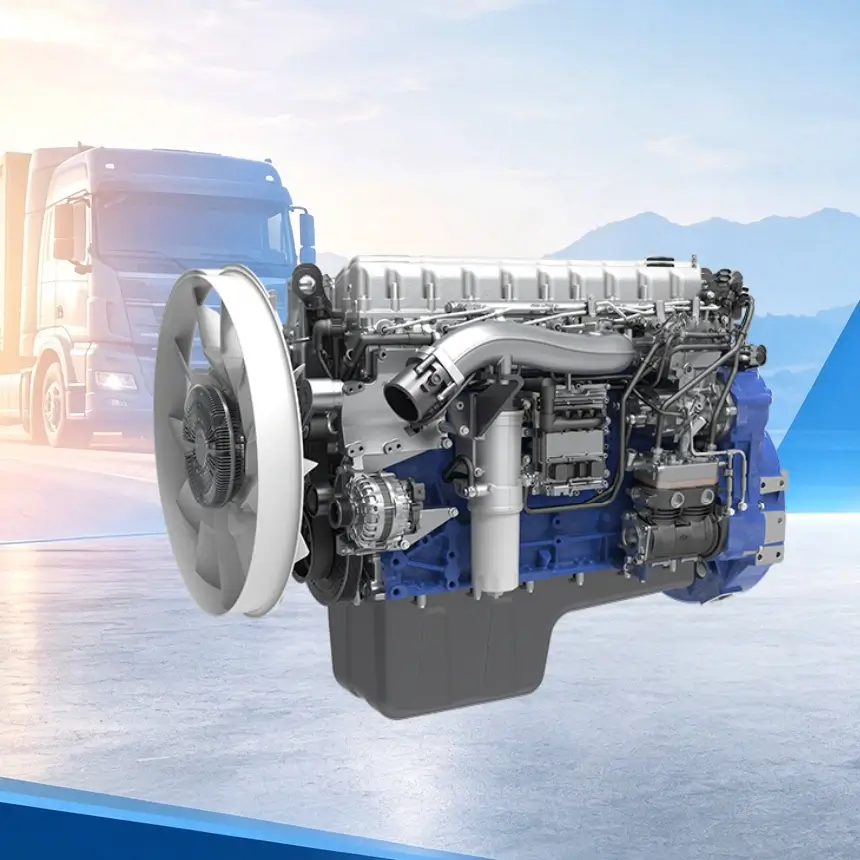
What Is the Weichai WP10H Diesel Engine?
The WP10H belongs to Weichai’s H-series platform, a family of engines developed for heavy-duty applications. As the successor to the original WP10, the WP10H features a redesigned architecture intended to improve power density, reduce weight, and enhance reliability. It is a 9.5-liter, in-line six-cylinder, four-stroke diesel engine with a bore of 116 mm, a stroke of 150 mm, and a compression ratio of 17.5:1.
For international markets, the WP10H is available in multiple emission configurations. The WP10H375E62 and WP10H400E62 are Euro VI models. Their fuel and exhaust systems use a common-rail (CR) fuel system combined with DOC, DPF, and SCR aftertreatment. Other WP10H variants are available for different emission requirements, depending on the model and market.
The engine is designed for heavy-duty work rather than passenger-car applications. It is intended for vehicles that operate under sustained loads, frequently travel on uneven roads, or work in demanding environments such as quarries and construction sites. In these applications, durability, serviceability, and fuel efficiency are important factors in fleet profitability.
Weichai WP10H Engine Technical Specifications
The following table compares the two Euro VI engine models covered in this guide.
| Parameter | Specification |
|---|---|
| Engine Model | WP10H375E62 / WP10H400E62 |
| Displacement | 9.5 L |
| Configuration | In-line 6-cylinder, four-stroke |
| Valves per Cylinder | 4 |
| Aspiration | Turbocharged and intercooled |
| Fuel System | Common rail |
| Bore × Stroke | 116 mm × 150 mm |
| Compression Ratio | 17.5:1 |
| Rated Power | WP10H375E62: 276 kW (375 PS) @ 1,900 rpm; WP10H400E62: 294 kW (400 PS) @ 1,900 rpm |
| Peak Torque | WP10H375E62: 1,800 N·m; WP10H400E62: 1,900 N·m |
| Peak Torque Speed | WP10H375E62: 1,000–1,400 rpm; WP10H400E62: 1,200–1,300 rpm |
| Emission Standard | Euro VI |
| Aftertreatment | CR + DOC + DPF + SCR |
| Dry Weight | Approximately 815 kg |
| Dimensions (L×W×H) | 1,196 × 1,026 × 1,133 mm |
Source: Weichai official product specifications. Dimensions and weight can vary with the specific engine configuration and equipment.
For parts buyers, one important point is that components should not be selected based on engine family names alone. Some components may be shared across related Weichai platforms, but crankshafts, pistons, cylinder heads, and other major components can be series-specific. Always verify the engine model, serial number, and original part number before ordering.
What Are the Main Advantages of the Weichai WP10H Engine?
Ultra-High Reliability
Weichai describes the H-series platform as having undergone extensive bench testing and vehicle road testing. The stated design life exceeds 1.8 million kilometers or 30,000 hours, depending on the applicable specification.
Actual service life depends on operating conditions, maintenance quality, load, fuel quality, and repair history. For a heavy-duty truck fleet, reliable performance and predictable maintenance can reduce downtime and improve vehicle availability.
Modular Design
The WP10H uses a modular component layout intended to simplify servicing and reduce component complexity. The fuel filter module integrates coarse and fine filtration into a single unit. The oil filter module combines filtration, cooling, and water-separation functions. The cylinder head incorporates an integrated intake manifold.
For workshops and fleet operators, an integrated design can simplify parts management and routine service. However, replacement modules should still be selected according to the exact engine configuration and applicable part number.
Lightweight Construction
The WP10H has a published dry weight of approximately 815 kg in the relevant truck-engine specifications. Its structural design and use of lightweight materials help reduce engine mass while maintaining the strength required for heavy-duty operation.
Lower engine weight can contribute to vehicle payload efficiency, although the actual payload benefit depends on the complete vehicle configuration rather than engine weight alone.
Fuel Efficiency
Weichai lists a minimum fuel consumption figure of approximately 181 g/kW·h for the WP10H platform. Its low-speed operating range is intended to support efficient performance under typical heavy-duty driving conditions.
Actual fuel consumption varies with vehicle weight, road conditions, transmission and axle ratios, driver behavior, engine condition, and maintenance. Fleet operators should evaluate fuel economy using real operating data rather than relying solely on laboratory or manufacturer figures.
High Braking Power
The WP10H platform features the WCBS in-cylinder braking system, with a published braking power of 226 kW at rated engine speed for the relevant configuration. It can be paired with a high-displacement air compressor rated at 630 L/min.
For dump trucks operating on downhill grades in mines or quarries, engine braking can help manage vehicle speed and reduce reliance on the service brakes. The braking system must be maintained and used according to the vehicle manufacturer’s instructions.
Altitude and Cold Adaptability
Weichai lists no power derating at altitudes up to 2,800 meters under specified operating conditions, with low power loss at 4,500 meters. The platform is also designed to support cold starting at temperatures down to -20°C under the specified conditions.
These characteristics may be useful for operators working in high-altitude mining regions and cold-climate markets. Actual starting performance and available power depend on the vehicle configuration, ambient conditions, fuel, battery condition, and maintenance.
What Are the Common Applications of the Weichai WP10H Engine?
Dump Trucks
The WP10H is used in heavy-duty dump trucks, including 6×4 and 8×4 configurations. Typical applications include construction, quarrying, mining-related transport, and urban construction-waste haulage.
In these environments, engines frequently experience high loads, repeated acceleration, low-speed operation, and long periods of idling during loading. Low-speed torque delivery and engine braking are therefore important operating characteristics.
Tractor Trucks and Cargo Trucks
The WP10H is also used in tractor trucks and cargo trucks. For long-distance transport, operators generally focus on fuel consumption, sustained power delivery, reliability, and service intervals.
The engine’s power and torque characteristics must be considered together with the transmission, axle ratio, vehicle weight, and intended route. These factors determine how effectively the engine performs in loaded highway operation.
Special-Purpose Vehicles
WP10H variants are used in special-purpose vehicles, including truck-mounted cranes, concrete mixer trucks, sanitation vehicles, and other heavy-duty applications, depending on the engine specification.
In mixer trucks, the powertrain must support both vehicle movement and the demands associated with the mixing equipment. In crane trucks and other PTO-equipped vehicles, the engine may also need to supply power to auxiliary systems. The selected engine configuration must match the vehicle manufacturer’s requirements.
How to Diagnose Common Weichai WP10H Engine Faults
The WP10H is designed for heavy-duty operation, but engine performance can still be affected by fuel-system problems, air restriction, cooling-system issues, and maintenance conditions. The following examples describe diagnostic considerations for common heavy-duty diesel symptoms.
Symptom 1: Heavy Black Smoke and Limited Engine Speed
A documented case involving a WP10 common-rail engine, which uses a related injector architecture, involved severe black smoke and an engine-speed limit of approximately 1,500 rpm. The reported cause was a missing copper washer at the No. 5 cylinder injector nozzle. Without the washer, combustion gases escaped around the injector, damaging the injector area and water jacket. The injector seized in the cylinder head and required careful removal.
This is a WP10 case, not proof that the same fault is a typical defect of every WP10H model.
Diagnostic approach:
- Read the engine fault codes and review live diagnostic data.
- Check for signs of combustion leakage around the injector base.
- Inspect injector installation and sealing components.
- Perform appropriate cylinder-balance or cutout tests according to the engine service procedure.
- Check the air intake and fuel system if black smoke and restricted engine speed persist.
Warning: Do not force a seized injector out of the cylinder head. Improper removal can damage the injector bore or cylinder head. If coolant has entered a cylinder, further cranking may cause serious engine damage.
Symptom 2: Power Loss and Elevated Exhaust Temperatures in Dusty Environments
In quarry and mining applications, restricted air intake and dust contamination can contribute to reduced engine performance. If fine dust passes through a damaged or incorrectly installed filter, it can accelerate wear on cylinder liners, piston rings, and turbocharger components.
Prevention:
- Inspect the air filter and pre-cleaner frequently in dusty conditions.
- Empty the dust bowl according to the applicable service instructions.
- Use the restriction indicator, where fitted, to determine when filter service is needed.
- Inspect intake hoses, clamps, and ducting for cracks or loose connections.
- Replace damaged filter elements rather than reinstalling them.
Dust protection is especially important for vehicles operating continuously on unpaved roads or in quarry environments.
Symptom 3: Coolant Loss and Overheating Under Load
Cooling-system problems can cause overheating during sustained heavy-duty operation. Dust and debris on the radiator or intercooler can reduce airflow, while low coolant levels, leaks, a faulty thermostat, or water-pump problems can also affect temperature control.
Prevention:
- Inspect the radiator and intercooler for external dirt and blocked fins.
- Clean cooling-system surfaces using the appropriate method and pressure.
- Check coolant level and concentration according to the service manual.
- Inspect hoses, connections, the radiator cap, and the water pump for leaks or damage.
- Investigate repeated overheating instead of continuing to operate the engine under excessive temperature.
In hot or dusty environments, cooling-system inspection should be included in routine fleet maintenance.
What Is the Recommended Weichai WP10H Engine Maintenance Schedule?
The following table presents the maintenance intervals used in the original service guidance for WP10H-powered vehicles. Actual intervals should be checked against the applicable engine and vehicle service manuals and adjusted for severe operating conditions such as mining, quarrying, and desert transport.
| Service Item | Standard / Long-Haul | Severe Duty (Mining/Quarry) |
|---|---|---|
| Engine oil and filter | 30,000–40,000 km | 10,000–15,000 km or 250–300 hours |
| Fuel filter | 30,000–40,000 km | 10,000–15,000 km |
| Air filter element | Per restriction indicator or 40,000 km | Inspect daily; replace on restriction |
| Coolant test | Every 6 months | Every 3 months |
| Belt and tensioner check | 30,000 km | 10,000 km or monthly |
| Turbo inspection | 60,000 km | 20,000–30,000 km |
| Valve clearance | 60,000 km | Halve the interval |
Source: Service guidance for WP10H-powered vehicles. Confirm the exact schedule for the relevant engine and vehicle configuration.
For mining fleets, engine hours may be more useful than distance alone when planning maintenance. A dump truck operating on short, steep haul routes can accumulate substantial engine hours while covering relatively few kilometers. Maintenance planning should therefore consider engine hours, duty cycle, fuel consumption, and the conditions specified by the manufacturer.
For coolant and aftertreatment on Euro VI variants, follow the relevant Weichai service instructions for shutdown procedures and SCR maintenance. The original service guidance referenced for this article specifies an automatic reverse-suction cycle after shutdown (T15 power off) lasting approximately two minutes, as well as urea-tank cleaning every 60,000 km or six months. Confirm that these instructions apply to the exact vehicle and aftertreatment configuration, and do not interrupt a required shutdown process by cutting battery power prematurely.
Which WP10H Engine Wear Parts and Replacement Components Are Available?
The WP10H uses a modular parts architecture, but filters, sealing components, and engine internals must still be selected according to the specific engine configuration. The following are commonly serviced components and the reference part numbers retained from the original parts information.
Filters and Consumables
| Component | Notes |
|---|---|
| Fuel filter module (coarse + fine) | Integrated design; verify the correct module before replacement |
| Oil filter module | Integrated filtration, cooling, and water-separation functions |
| Air filter element | Follow the restriction indicator and applicable service instructions |
| Urea pump filter (Euro VI) | Service according to the aftertreatment system’s maintenance instructions |
Engine Internals
| Component | Reference Part Number (aftermarket) |
|---|---|
| Cylinder head (complete) | 611600040032 |
| Cylinder liner / back-up block | 1000400296 |
| Connecting rod upper shell | 611600030006 |
| Keystone barrel ring | 611600030021 |
| Flywheel bolt | 1000382895 |
Parts sourcing caution: Major engine components must be matched to the exact engine model and serial number. Small differences in dimensions, materials, or manufacturing tolerances can affect sealing, lubrication, and long-term durability. Do not assume that a part fits simply because it is listed for another WP10-family engine.
For workshops, distributors, and fleet maintenance teams, confirming the original part number before purchasing can reduce ordering errors and avoid unnecessary vehicle downtime.
Pioneer Diesel Parts supplies aftermarket diesel fuel-system components and other diesel engine parts for professional buyers. If you need help identifying a suitable replacement, send the engine model, engine serial number where available, original part number, and required quantity for compatibility verification and a quotation.
More Weichai Engine Guides
- Weichai WP10.5H Engine Applications in Heavy-Duty Tractor Trucks and Cargo Transport
- Weichai WP12 Engine Applications in Tractor Trucks, Cargo Trucks and Dump Trucks
- Weichai WP12T/H/Q Engine Applications in Heavy-Duty Tractor Trucks and Long-Haul Transport
- Weichai WP13 Engine Applications in Concrete Mixer Trucks, Truck Cranes and Special-Purpose Vehicles
Read more:
- WP3N Engine
- WP14T Engine
- Weichai WP14T/H/Q Engine Applications in Heavy-Duty Tractor Trucks and Construction Transport
- Weichai WP15T/Hs/Q Engine Applications in High-Power Tractor Trucks and Heavy-Duty Freight Transport
Frequently Asked Questions About the Weichai WP10H Engine
What Is the Difference Between the WP10 and WP10H?
The WP10H is a redesigned successor platform to the WP10, featuring updated engine structure, cylinder-head design, and filtration systems. Major components are not necessarily interchangeable, so verify part numbers before ordering.
Can the WP10H Be Used in a Generator or Pump?
The WP10H is primarily designed for heavy-duty vehicles. Generator and pump applications may require different power ratings, governor settings, and cooling systems. Confirm suitability with the manufacturer before installation.
What Emission Standards Does the WP10H Meet?
The WP10H family includes different emission configurations. The WP10H375E62 and WP10H400E62 are Euro VI models equipped with common-rail fuel injection and DOC, DPF, and SCR aftertreatment.
What Vehicles Use the Weichai WP10H Engine?
The WP10H is used in heavy-duty tractor trucks, cargo trucks, dump trucks, and selected special-purpose vehicles. Vehicle compatibility depends on the engine version and original vehicle specification.
What Is the Difference Between the WP10H375E62 and WP10H400E62?
The WP10H375E62 delivers 276 kW (375 PS) and 1,800 N·m of torque at 1,000–1,400 rpm. The WP10H400E62 produces 294 kW (400 PS) and 1,900 N·m at 1,200–1,300 rpm.
What Fuel System Does the WP10H Use?
The WP10H375E62 and WP10H400E62 use a common-rail fuel injection system. When replacing injectors, fuel pumps, or related components, verify compatibility using the exact engine model and part number.
How Do You Identify the Correct Replacement Parts for a WP10H Engine?
Check the engine model, serial number, and original part number. Clear photos of the old component and its markings can also help. Pioneer Diesel Parts can assist with compatibility checks and quotations when you provide these details.
Conclusion
The Weichai WP10H375E62 and WP10H400E62 are designed for demanding heavy-duty applications, including dump trucks, tractor trucks, and construction vehicles. Understanding their specifications, operating characteristics, maintenance requirements, and replacement parts helps fleet operators and repair workshops maintain reliable engine performance and reduce unnecessary downtime.
When sourcing replacement diesel engine parts, accurate identification is essential. Similar engine models may use different components, so always verify compatibility before placing an order.
Need parts for a Weichai WP10H engine? Pioneer Diesel Parts assists truck repair workshops, fleet maintenance teams, and diesel parts distributors with replacement parts inquiries. Send us your engine model, engine serial number, or part number from the old component, along with the required quantity. Photos of the existing part or its identification markings can also help with verification.
Contact Pioneer Diesel Parts for part-number checking, compatibility confirmation, and a quotation for your requirements.